Developed by Yang Jie and Dai Xiaoyang, the Zhongyong Practical Thinking Scale assesses everyday use of zhongyong thinking across appropriateness and moderation, inner and outer harmony, and yin–yang transformation.
Before you begin
Find a quiet place
Answer each question honestly
Trust your first response; avoid overthinking
For self-understanding. Not a professional diagnosis.
Personality
About This Test
Developed by Yang Jie and Dai Xiaoyang, the Zhongyong Practical Thinking Scale assesses everyday use of zhongyong thinking across appropriateness and moderation, inner and outer harmony, and yin–yang transformation.
The Zhongyong Practical Thinking Scale is based on the Zhongyong Practical Thinking System developed by Yang Zhongfang and the team.
Zhongyong practical thinking guides how people make choices, act, and correct their actions. It is an everyday Chinese thinking style and a metacognitive framework. Its central idea is to consider both extremes and find an appropriate middle course, responding to actual circumstances impartially and doing neither too much nor too little.
The scale contains 18 items covering 3 dimensions:
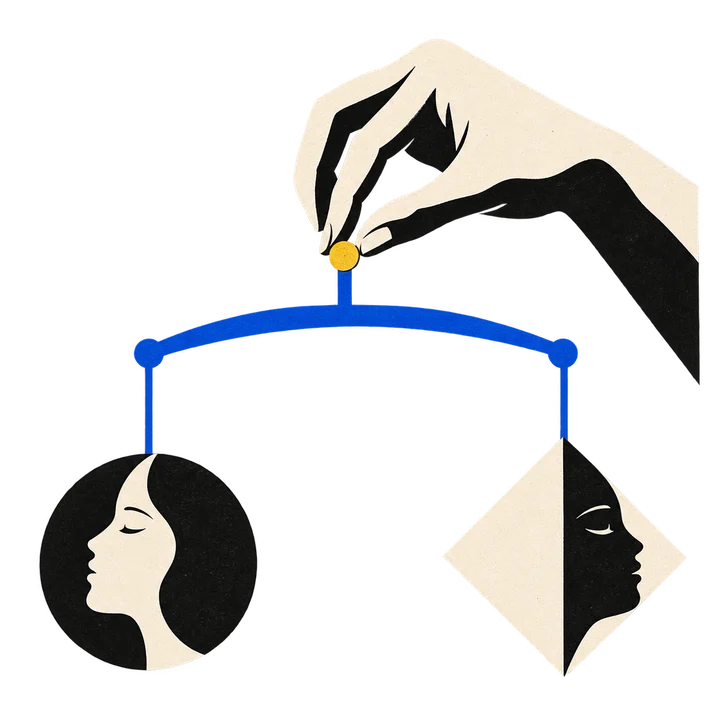
- Appropriateness and moderation: responding to problems with a sense of proportion.
- Inner and outer harmony: considering several perspectives and maintaining harmony within oneself and with the environment.
- Yin–yang transformation: understanding both sides of situations and how they transform into one another.
Research associates this thinking style with better mental health.
What This Test Measures
Appropriateness and moderation
The ability to respond to situations, problems, or conflicts in a measured way, doing neither too much nor too little
Inner and outer harmony
The ability to consider different perspectives on events or relationships and understand their development before, during, and after they occur
Yin–yang transformation
Understanding the two sides of a situation and how, under certain conditions, they can turn into one another, with one increasing as the other declines
Frequently Asked Questions
Yang Jie and Dai Xiaoyang developed this scale based on the Zhongyong Practical Thinking System created by Yang Zhongfang's team. It assesses the use of zhongyong thinking in everyday life. Rooted in traditional Chinese culture, zhongyong means considering both extremes and finding an appropriate middle course: responding to circumstances impartially, doing neither too much nor too little. It is a metacognitive framework guiding choices, actions, and corrections. The scale has 18 items across 3 dimensions: ① Appropriateness and moderation (7 items): handling problems with a sense of proportion. ② Inner and outer harmony (6 items): considering different perspectives and maintaining harmony within oneself and with the environment. ③ Yin–yang transformation (5 items): understanding both sides of a situation and how they can turn into one another.
The scale uses four response points (0–3), with 5 positively scored and 13 reverse-scored items, for a total of 0–54. Higher scores indicate more zhongyong thinking. Totals of ≤18 are low, 19–32 below average, 33–42 moderate, and 43–54 good. The threshold is 32: scores >32 (33–54) fall within the normal range, while ≤32 (0–32) warrant attention. ① Appropriateness and moderation, maximum 21: high scores indicate proportionate responses without extremes; low scores suggest difficulty with moderation. ② Inner and outer harmony, maximum 18: high scores indicate harmony and varied perspectives; low scores suggest feeling out of sync with one's environment. ③ Yin–yang transformation, maximum 15: high scores indicate dialectical thinking and understanding of both sides; low scores suggest one-sided thinking and difficulty recognizing transformation.
The scale suits adolescents and adults with at least a junior secondary education and some familiarity with traditional Chinese culture. It can help: ① Individuals understand their thinking style. ② Counselors explore clients' cognitive patterns. ③ Researchers study links with mental health and social adjustment. ④ Managers assess employees' flexibility and adaptability. ⑤ Educators develop students' dialectical thinking. Because zhongyong is rooted in traditional Chinese culture, the scale works best with people from that cultural context. Research associates this thinking style with better mental health, stronger social adjustment, and more harmonious relationships.
These are common misunderstandings. Zhongyong is a thoughtful approach rather than simply smoothing over disagreements or abandoning principles. ① It considers both extremes and chooses what best fits the situation, rather than automatically compromising. ② It has a clear principle: responding appropriately, doing neither too much nor too little. ③ Judging the right degree requires careful understanding of the situation rather than having no position. ④ Flexibility means adjusting strategies while retaining core values. In a conflict, for example, it does not mean blaming both sides equally; it means understanding both positions and finding a solution that resolves the problem while preserving the relationship. This calls for judgment, experience, and sensitivity to context.
This thinking style can develop through learning and practice. ① Learn dialectical thinking: situations have positive and negative aspects that can transform under certain conditions; practice seeing several perspectives. ② Develop a sense of proportion: avoid extremes and ask, 'Am I doing too much or too little?' ③ Become sensitive to context and adapt rather than using the same approach everywhere. ④ Consider your own and others' perspectives, and both short- and long-term effects. ⑤ Explore traditional Chinese culture through texts such as the Doctrine of the Mean and Tao Te Ching. ⑥ Reflect on daily experiences: did you go to an extreme or consider several factors? ⑦ Ask others for feedback to identify blind spots. Continued learning and practice can gradually strengthen these skills.
The two approaches share an emphasis on dual aspects and unity within contradiction, change and development, and avoiding absolute or one-sided judgments. They also differ. ① Cultural roots: zhongyong draws on Confucian and Daoist traditions, emphasizing harmony, balance, and moderation; Western dialectics draws on ancient Greek philosophy and Hegel and Marx, emphasizing conflict and development. ② Focus: zhongyong seeks an appropriate course between extremes; Western dialectics emphasizes the unity of opposites and development as an upward spiral. ③ Practice: zhongyong stresses practical wisdom in everyday choices; Western dialectics emphasizes theoretical analysis and logical reasoning. ④ Values: zhongyong emphasizes harmony, impartiality, and a middle course; Western dialectics emphasizes development, progress, and the negation of negation. The approaches can complement each other and enrich how we think.
If your total is ≤32 and any of these concerns apply, consider professional counseling: ① Extreme responses frequently cause conflicts or work problems. ② Rigid thinking makes change difficult and distressing. ③ You often feel unable to fit into your surroundings. ④ A very low moderation score accompanies consistently excessive or insufficient responses that affect quality of life. ⑤ A very low harmony score accompanies strong inner conflict or difficulty balancing your needs with others'. ⑥ A very low transformation score accompanies inflexible, black-and-white thinking. A counselor can help explore these patterns' roots, develop more flexible and adaptive thinking, build dialectical thinking skills and a sense of proportion, and improve social adjustment and mental health. This scale is an assessment tool and cannot replace professional assessment or diagnosis.
This test is for learning and self-understanding. It cannot replace professional medical advice, diagnosis, or treatment. If you are in significant distress, seek help from a healthcare professional.